

stewartwillsher
Well-Known Member
- Joined
- May 15, 2017
- Messages
- 1,111
- Reaction score
- 98
- Points
- 48
- Location
- Western Spain and Costa de la Luz
WAFFLE ALERT!!
In another thread, I asked "My first two cars could be decoked in under an hour! How was this possible?"
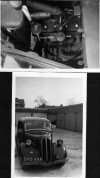
Answer: They were both 1172cc 4cyl sidevalve Fords; the first being a 1938 E93A, the second a 1955 100E, and both, coincidentally, carried the name "Anglia".
Loads of space under the bonnet on the old bangers so nothing irrelevant to disturb.
One screw - lift off distributor.
Think I took off air cleaner as it made more space - another screw.
Drain plug - lower coolant to below head level.
Two screws and hose clip - to remove top hose.
Dozen-ish head bolts - unscrew.
Whack head with mallet to loosen and lift off.
Chisel off old head gasket (not always a quick job!).
Remove spark plugs; clean and reset gaps.
Scrape carbon off head and daintily round valves in block.
Coat new head gasket with red Hermatite or similar.
Replace head; tighten bolts in recommended order.
Screw in spark plugs.
Replace top hose.
Drop distributor back in (lined up same as removed) and connect leads.
Air cleaner back on if removed.
Top up coolant.
Think that's about it - it was about fifty five years ago, so I might have missed something.
Oh, and that was all done in the street; usually with one or more helpful neighbours, sucking their teeth and saying "nah, you don't want to do it like that mate ....".
As a fresh faced kid, I listened to their advice, then did it according to the manual I had just read and the input from the rally and race mechanics I rubbed shoulders with.
Now I know decoking seems not to be a very frequent requirement, however, the old E93A was a bit thirsty on oil.
In those days (1962) if you had an old smoker, you could buy, at the local motorists' shop, reclaimed oil at five bob (25p in today's money) a gallon.
This was when petrol was under three bob a gallon.
Where the consumption was really noticeable was on longish runs.
As a car nut, I attended many races, and was an accredited marshal, so often the Sunday trip was from the East End of London where I lived to Snetterton circuit in Norfolk, each way being about ninety miles.
There were plenty of laybys for my oil top up stop, somewhere about half way.
Top up again before heading homeward, and another stopping point about halfway. That round trip of one hundred and eighty miles used up a complete gallon of oil.
So decokes were desirable!
A couple of other features of that car were the six volt electrics and the well worn mechanicals.
There was a starter, but only if the engine was warmed up was there any point in puling the knob, and even then it reluctantly groaned as the engine slowly turned.
Start sequence was - bonnet up on passenger side; prime carb by pressing plunger until it dripped; choke half out (full if a frosty day); starting handle through bumper to engage in end of crank shaft; grip with thumb same side as fingers (kick back if thumb wrong side would be visit to medics); half a turn to get fuel into manifold; full sharp pull to start. And it usually did first or second yank.
Quickly adjust choke before it starved or flooded, and off we went.
At night the lights were a joke - more like candles.
Coming home from Snetterton down the old single carriageway A11, there was little traffic, and what there was were quicker motors than mine.
So as dusk fell, my mate would hang out the passenger window giving me a clue as to how far I was from the grass verge.
Then joy, a car would come from behind and light up the road ahead; but only briefly, because as soon as possible they would overtake and whilst I would go like the clappers to keep up (maybe fifty if lucky with a following wind) for as long as I could see where he was going, but when he went round a bend ahead, I was immediately blind and relying on my mate's night vision again.
The car had trafficators, the predecessor of flashing indicators.
They were in each door pillar and when the switch to whichever side was activated, this arm emerged from its vertical slumber, to ninety degrees, and on reaching that point a festoon bulb lit which glowed through the yellow plastic bit on the underside of the arm.
How wonderful; well not quite, because six volt solenoids are a bit weak so at any speed the wind resistance was fighting the awesome power available.
All was not lost, because a few hefty thumps on the door pillar by driver or passenger depending on right or left indication, and the erection (pardon) was hastened.
In any case the cancellation was not powered and relied on gravity.
No chance, so more hammering on door pillar was required to return trafficator arm to its nest.
Wipers were not electric but activated by vacuum directly from the inlet manifold.
The challenge was to adjust the demands of the road conditions related to use of the accelerator to be compatible with the sweep of the wiper blades.
This was almost impossible and any kind of incline upward caused the wipers to stop in their tracks.
So seeing a hill coming when it was raining meant taking a run at it and backing off the throttle a few times when going up to let the wipers wipe.
But a quaint feature of the 1938 Ford Ten was a wind out front windscreen.
So as a last resort to aid visibility, the bottom of the screen was wound out to provide a couple of inches of letterbox vision, if you lowered your head to peer through the steering wheel and gap.
Whilst mentioning the steering wheel, I have to own up to having driven the banger for over a year in an unroadworthy state by today's standards.
There was nearly a quarter turn of slop in the steering, so much so that it was prudent to look ahead for camber changes and other road surface anomalies and take up the slack at the precise moment the terrain changed; if not there were some frightening lurches and corrections, guaranteed to up the pulse rate of all aboard.
The brakes were "curate's egg", with the handbrake excellent, activated by a long sort of umbrella handle, whereas the normal brakes left a lot to be desired and much anticipation needed; many's the time I and passengers held our breath and the full force of my body applied to the pedal to avoid contact of an obstacle ahead or the risk of running off the road. It must have had an invisible ahead-of-its-time ABS, because I think it was impossible to lock up even on dodgy surfaces.
The winter of 1962 earned me a few bob; well the banger did really; because the newer cars had no starting handle, and although twelve volt, the systems were less than capable in the very cold weather of starting anything but the perfectly tuned engine.
With a hefty tow rope I jump started neigbours, or anyone needing it, for a couple of bob a pull.
The handbrake was fun in the snow; my favourite trick being to park against the kerb by applyong handbrake whilst turning and aiming at a parking space, and letting the camber slide it in sideways.
The skinny wheels helped to be a prat on snow and ice, cutting through enough to help steering.
What all the above did achieve was to teach me to drive.
Having obtained my provisional licence and set out on my first lessons on my seventeenth, the instructor gave me a wary look and interrogated me as to how I needed no more lessons, and put me in for the test.
I insisted no driving on the public highway had taken place before my birthday, but that marshalling at race meetings and autocross, I had driven several motors, so had mastered the controls. The rest was in the Highway Code, guv'!
Within days of my pink slip (pass cert) I had bought the old banger, above, for twenty five quid and drove it home, no probs.
I managed to get myself a speeding ticket after a few months, of which I was justifiably (not according to my father) proud because the charmless nerk wrote down "over fifty miles per hour".
He snuck out of a side turning on a motor bike and tailed me for long enough to make it stick.
You'd think he would have congratulated me, but it was "let's teach this young'n a lesson".
It did, because I was more observant from then on.
Pleaded guilty by letter, as I might have been cocky in court.
After a year battling with the quirks of the banger, I flogged it for twenty five quid and bought a 100E so I could rally and autocross myself, and not just watch.
But that, as they say, is another story!!!!
In another thread, I asked "My first two cars could be decoked in under an hour! How was this possible?"
Answer: They were both 1172cc 4cyl sidevalve Fords; the first being a 1938 E93A, the second a 1955 100E, and both, coincidentally, carried the name "Anglia".
Loads of space under the bonnet on the old bangers so nothing irrelevant to disturb.
One screw - lift off distributor.
Think I took off air cleaner as it made more space - another screw.
Drain plug - lower coolant to below head level.
Two screws and hose clip - to remove top hose.
Dozen-ish head bolts - unscrew.
Whack head with mallet to loosen and lift off.
Chisel off old head gasket (not always a quick job!).
Remove spark plugs; clean and reset gaps.
Scrape carbon off head and daintily round valves in block.
Coat new head gasket with red Hermatite or similar.
Replace head; tighten bolts in recommended order.
Screw in spark plugs.
Replace top hose.
Drop distributor back in (lined up same as removed) and connect leads.
Air cleaner back on if removed.
Top up coolant.
Think that's about it - it was about fifty five years ago, so I might have missed something.
Oh, and that was all done in the street; usually with one or more helpful neighbours, sucking their teeth and saying "nah, you don't want to do it like that mate ....".
As a fresh faced kid, I listened to their advice, then did it according to the manual I had just read and the input from the rally and race mechanics I rubbed shoulders with.
Now I know decoking seems not to be a very frequent requirement, however, the old E93A was a bit thirsty on oil.
In those days (1962) if you had an old smoker, you could buy, at the local motorists' shop, reclaimed oil at five bob (25p in today's money) a gallon.
This was when petrol was under three bob a gallon.
Where the consumption was really noticeable was on longish runs.
As a car nut, I attended many races, and was an accredited marshal, so often the Sunday trip was from the East End of London where I lived to Snetterton circuit in Norfolk, each way being about ninety miles.
There were plenty of laybys for my oil top up stop, somewhere about half way.
Top up again before heading homeward, and another stopping point about halfway. That round trip of one hundred and eighty miles used up a complete gallon of oil.
So decokes were desirable!
A couple of other features of that car were the six volt electrics and the well worn mechanicals.
There was a starter, but only if the engine was warmed up was there any point in puling the knob, and even then it reluctantly groaned as the engine slowly turned.
Start sequence was - bonnet up on passenger side; prime carb by pressing plunger until it dripped; choke half out (full if a frosty day); starting handle through bumper to engage in end of crank shaft; grip with thumb same side as fingers (kick back if thumb wrong side would be visit to medics); half a turn to get fuel into manifold; full sharp pull to start. And it usually did first or second yank.
Quickly adjust choke before it starved or flooded, and off we went.
At night the lights were a joke - more like candles.
Coming home from Snetterton down the old single carriageway A11, there was little traffic, and what there was were quicker motors than mine.
So as dusk fell, my mate would hang out the passenger window giving me a clue as to how far I was from the grass verge.
Then joy, a car would come from behind and light up the road ahead; but only briefly, because as soon as possible they would overtake and whilst I would go like the clappers to keep up (maybe fifty if lucky with a following wind) for as long as I could see where he was going, but when he went round a bend ahead, I was immediately blind and relying on my mate's night vision again.
The car had trafficators, the predecessor of flashing indicators.
They were in each door pillar and when the switch to whichever side was activated, this arm emerged from its vertical slumber, to ninety degrees, and on reaching that point a festoon bulb lit which glowed through the yellow plastic bit on the underside of the arm.
How wonderful; well not quite, because six volt solenoids are a bit weak so at any speed the wind resistance was fighting the awesome power available.
All was not lost, because a few hefty thumps on the door pillar by driver or passenger depending on right or left indication, and the erection (pardon) was hastened.
In any case the cancellation was not powered and relied on gravity.
No chance, so more hammering on door pillar was required to return trafficator arm to its nest.
Wipers were not electric but activated by vacuum directly from the inlet manifold.
The challenge was to adjust the demands of the road conditions related to use of the accelerator to be compatible with the sweep of the wiper blades.
This was almost impossible and any kind of incline upward caused the wipers to stop in their tracks.
So seeing a hill coming when it was raining meant taking a run at it and backing off the throttle a few times when going up to let the wipers wipe.
But a quaint feature of the 1938 Ford Ten was a wind out front windscreen.
So as a last resort to aid visibility, the bottom of the screen was wound out to provide a couple of inches of letterbox vision, if you lowered your head to peer through the steering wheel and gap.
Whilst mentioning the steering wheel, I have to own up to having driven the banger for over a year in an unroadworthy state by today's standards.
There was nearly a quarter turn of slop in the steering, so much so that it was prudent to look ahead for camber changes and other road surface anomalies and take up the slack at the precise moment the terrain changed; if not there were some frightening lurches and corrections, guaranteed to up the pulse rate of all aboard.
The brakes were "curate's egg", with the handbrake excellent, activated by a long sort of umbrella handle, whereas the normal brakes left a lot to be desired and much anticipation needed; many's the time I and passengers held our breath and the full force of my body applied to the pedal to avoid contact of an obstacle ahead or the risk of running off the road. It must have had an invisible ahead-of-its-time ABS, because I think it was impossible to lock up even on dodgy surfaces.
The winter of 1962 earned me a few bob; well the banger did really; because the newer cars had no starting handle, and although twelve volt, the systems were less than capable in the very cold weather of starting anything but the perfectly tuned engine.
With a hefty tow rope I jump started neigbours, or anyone needing it, for a couple of bob a pull.
The handbrake was fun in the snow; my favourite trick being to park against the kerb by applyong handbrake whilst turning and aiming at a parking space, and letting the camber slide it in sideways.
The skinny wheels helped to be a prat on snow and ice, cutting through enough to help steering.
What all the above did achieve was to teach me to drive.
Having obtained my provisional licence and set out on my first lessons on my seventeenth, the instructor gave me a wary look and interrogated me as to how I needed no more lessons, and put me in for the test.
I insisted no driving on the public highway had taken place before my birthday, but that marshalling at race meetings and autocross, I had driven several motors, so had mastered the controls. The rest was in the Highway Code, guv'!
Within days of my pink slip (pass cert) I had bought the old banger, above, for twenty five quid and drove it home, no probs.
I managed to get myself a speeding ticket after a few months, of which I was justifiably (not according to my father) proud because the charmless nerk wrote down "over fifty miles per hour".
He snuck out of a side turning on a motor bike and tailed me for long enough to make it stick.
You'd think he would have congratulated me, but it was "let's teach this young'n a lesson".
It did, because I was more observant from then on.
Pleaded guilty by letter, as I might have been cocky in court.
After a year battling with the quirks of the banger, I flogged it for twenty five quid and bought a 100E so I could rally and autocross myself, and not just watch.
But that, as they say, is another story!!!!
Attachments
-
 ford10.jpg27.8 KB · Views: 793
 -
 ford10x.jpg20.4 KB · Views: 793